How To Get You and Your Students Improvising #thatmusicimprovteacher

This article will be in Music Teacher Association Ensemble Magazine Autumn 2025 edition, available to MTA Members:

To join, click here https://www.musicteachers.org/join-us/

Hello all! I hope you have all begun the year well and have already used some improvising techniques with your students!

I offer you some tips and a sample lesson plan to get your students improvising in music and present some tips on assessing and strategies on how you can embed improvisation in your teaching.

But first, a reminder:

Improvisation is often thought of as spontaneous musical creativity, i.e. an “on the spot” exercise, but as I have mentioned in previous editions and articles, it is actually built upon a foundation of learned vocabulary, developed through practice, and carefully scaffolded by the teacher to break down into manageable chunks. It is necessary for you and your students to build a memory bank of ideas, rhythms and patterns to recall them at any moment (think of this as one’s music improv vocabulary), having the confidence and play to manipulate them in the moment. This is why students freeze when asked to improvise; they probably have nothing to draw upon!

Advice for your Students  

For keyboard/Xylophone players, the pentatonic notes and major/minor are valuable for accessibility. They represent differentiation by colour and shapes and provide an almost guaranteed fail-safe to not play ‘wrong’ notes. The pentatonic scale is the safest space for initial improvisation, before moving to more challenging scales. I suggest narrowing the key range (e.g., one octave) and having students use triads/dyads for any chordal accompaniment.

But what if they hit the ‘wrong’ note?!

Paraphrasing Miles Davis here, there is no such thing as ‘wrong’ notes in improvisation. If your students were to stumble across a wrong note, tell them they are but one note away from the ‘right’ note. Jazzers call these ‘passing tones’, chromatic links to notes within a scale, e.g. play a C# over a C7 chord? No problem! Move up a semitone to a D to make a lovely C9 sound or down a semitone to play the tonic.

Students may benefit from recording their improvisations by writing or recording them. This helps build their memory bank of ideas and track their progress, satisfying learning progression, demonstrating aural skills and showing understanding of the learning outcomes.

Tips for Teachers

  • Start Small: You don’t need to be a jazz expert to teach improvisation. Begin with pentatonic scales/limited major and minor scales. Develop call-and-response activities to include more choices for responses.
  • Be Honest: It’s ok to share that you are not the most confident improviser unless you say, ‘I’m rubbish at this kids’ in which case, best to keep it to yourself! Turn the activity into a joint learning venture and choose the model of improvisation that you feel most comfortable with.
  • Use Technology or Models: Backing tracks, ostinati loops, or recorded examples help set a framework for improv. DAWs can be an excellent tool for students to experiment without being heard, and you can save progress.
  • Seek CPD and Support: My research on secondary school improvisation showed that many teachers have had little to no opportunities to develop as improvisers during their musical and teacher training. Whilst jazz academics like Barry Harris or Ed Sarath offer wisdom on how musicians can develop, it caters to more experienced improvisers. Jazz in Education UK founders Pauline Black and Simon Purcell, both as influential as the former two, help those taking the first steps into teaching improvisation.
  • Model Risk‑Taking: Play an imperfect improvisation, play how the ‘wrong’ notes work in an improvisation, take a well-known melody and improvise around it. Show your students that music can be manipulated into anything you want it to sound like!

Sample Lesson Plan for Teaching Improvised Melody (a Focus on Rhythm). 55-60mins

  1. Warm-Up: Body Call-and-Response
    • Teacher uses body percussion for students to echo, turning it into a fun musical register rather than saying their names. Improvise accessible rhythmic ideas first, then move on to a selection of rhythms on the board (no more than four, scaffold the difficulty and include some known ones). Do the C&R again but have students respond with any they wish after learning them.
  2. Model: Use of Pentatonic Notes on the piano w. Rhythmic Templates
    • Demonstrate how to use any rhythmic templates combined with the pentatonic scale. Start with two notes, then three etc. Ensure you show that you are improvising the selection of notes and recycling them at will.
  3. Lesson Task: Practice Improvisation
    • Students go in pairs, select rhythm(s) from the worksheet/from the board, then improvise note choices over the rhythm. Build confidence by starting with two notes, then three etc. More confident students can add C and F to the scale to create modal possibilities.
  4. Performance
    • Play a chord vamp/use a backing track. Get the pairs to play their improvisations one by one.
  5. Plenary
    • Think Pair Share the following questions:
      • Which rhythm(s) did you enjoy improvising around?
      • Which combination of notes from the pentatonic scale did you enjoy using?
      • What happened when you made a ‘mistake’?
      • Which improvisations from the group were memorable?

Final Thoughts

The benefit of teaching music improvisation is that one can find ways of creating/devising through play. Anything can be improvised! Provided you believe it can. I got one of my ensemble students to improvise the opening of Vivaldi’s Winter on the flute by getting him to reorder the bars. Granted, some passages did not work, but most did, as they added to his improv vocabulary. Improvisation is trial and error, but who is to say that a particular idea won’t work in another context?

By changing our relationship with the ‘notated score’ as Tim Palmer puts it, one can view music not necessarily as a collection of dots and symbols to perform, but as an act of expression, discovery and adventure. Embrace the uncertainty, scaffold wisely, and watch your students (and perhaps yourself!) grow into confident, spontaneous musical voices.

Please do get in touch if you are interested in me running a session/programme to help your students/department develop improvisation.

Make sure to include any examples, successes or ideas using #thatmusicimprovteacher on your social media.

mwrightbass@gmail.com

LinkedIn – mwrightmusic

Music Improvisation in UK Secondary Schools: Part 8

In this series, I will present parts of my dissertation, ‘What strategies, activities and methods would help develop the teaching of music improvisation in UK secondary school education?’. I aim to give you insight into my improvisation research by informally presenting my findings, opinions and thoughts. It may start a discussion of the justifications, merits, and advocations for music improvisation or completely put you off and double down on why improvisation should be left out of music education. Either way, I believe it’s a meaningful conversation.

Results from Interviews & Conclusion

Background

The interviews highlighted the individual pursuit of learning improvisation and an inquisitive mind to find answers to questions their secondary education did not ask. Their experiences highlighted a divide in music education, whereby improvisation did not feature in their school education, or worse, was treated with a callous dismissal in ID B’s discovery of improvisation. For other examples, teachers were well-meaning but ill-informed to give proper assistance in developing improvisation skills. For ID C, improvisation was barely featured in his secondary education due to the pre-eminence of Western classical learning. The survey showed that only a few teachers come from an improvisational background in training as musicians and teachers. However, most teachers use improvisation in their curriculum (just under half for co/extracurricular). By anonymising the identities and backgrounds, the data did not represent a true reflection of their experiences. In hindsight, it should have been captured as an open-ended question like the one asked of the interviewees. This was a missed opportunity to look at the phenomenology between the survey and interviews to see how the experiences compare, such as the divide between secondary education’s relationship with improvising. Where is the duality between curricula and self-learning improvisation? And what is the role of an explorative mindset in learning improvisation?   

Definition 

Regardless of improvisational background, references to spontaneity and expressive and momentary music making were identified as characteristics of improvisation. These characteristics will be essential to secondary teachers in creating rationales for strategies, activities, and methods and advocating improvisation in one’s practice. Improvisation as a musical language (musicianship, notation and music theory) could eliminate barriers to demystifying improvisation by describing it as a language linked with human experience. Mentioning composition was an interesting definition that can also help bridge a better understanding of improvisation in secondary. Teachers have a better chance of promoting strategies, activities, and methods for devising, embellishing, and experimenting with musical ideas while not taking students out of their comfort zones to create improvisation (ID D).

Genre 

Genre-led teaching of improvisation featured heavily in the interviews and survey questionnaire. This may have been due to an association that genres such as jazz strongly linked to improvisation (Larsson & Georgii-Hemming 2018). A potential issue with this association is secondary teachers presuming that to teach improvisation, one must know jazz music. When designing the project, there was no emphasis placed on genre, as the intention was for participants to reveal their opinions on genre’s role when teaching improvisation. Not mentioning genre in the survey questionnaire and interview invitations should have clarified any ‘assumptions, world view and theoretical orientation at the outset of the study’ (Merriam 1988, 169). As a result, jazz and blues emerged as preferred genres, which could cause issues for teachers unfamiliar with the genres wishing to teach improvisation. Further studies on other genres, such as Early music and Indian classical, will be beneficial in ascertaining if these genres would be suitable for improvisation in secondary school. 

Strategies, Activities and Methods

The interviews shared different perspectives on what would be effective when teaching secondary improvisation. ID A’s emphasis on the neurological approach, ‘right brain’ activities and methods based on rhythm, pulse, groove and repetition is reminiscent of Sarath’s advocation for his Transstylistic method, as both mentioned repetitive framework for rhythm underpinned by a melodic and harmonic pitch framework (Sarath 2009), backed up the survey. ID B’s focused on the ‘pitch framework’ too, with the use of rhythm implied in his examples but not the main focus. ID C’s concentrated on learning by listening, genre attributes and composition by devising tied in with musical elements based on strategy and method. They also offered good exemplars for secondary teachers to use, playing the first chorus of a solo only. This advice is useful, teachers will need to take care in the exemplars they select to not put off students by making them feel improvisaiton is unobtainable.

All four represent strata for improvisation pedagogy, with the survey questionnaire sampling strategies, activities and methods mainly in line with Simon’s approach to curricular teaching. Cocurricular’s data was surprising in that it offered fewer suggestions. The presumption was that teachers would use strategies, activities, and methods in cocurricular activities because there would be more opportunities for improvisation and fewer limitations to contend with in curriculum teaching.  

Away from a more prescribed approach, the survey’s sugestion of improvisation for special needs schools deserves some consideration. Using sounding boards and allowing their students to improvise with an open scaffolding could be a great way to introduce improvisation to a group already confident with instrumental skills and have the freedom to play without restrictions. The concern is that it takes secondary improvisation back to the original issue of lacking formal strategies, activities, and methods. However, special needs and music therapists’ teachings could provide ‘a psychological template.’ (ID A) for teachers to use.

The use of improvisation at SEN schools is also worth noting due to its flexibility and explorative nature. Using assessable musical instruments for students to improvise with an open scaffolded approach could be a great way to introduce improvisation to a group already content with instrumental playing and freedom to play without restrictions. There is potential to expand improvisation pedagogy and research in the SEN area (SEN and music therapists’ teachings could provide a psychological template for teachers to use) and, most certainly, at the primary education level.

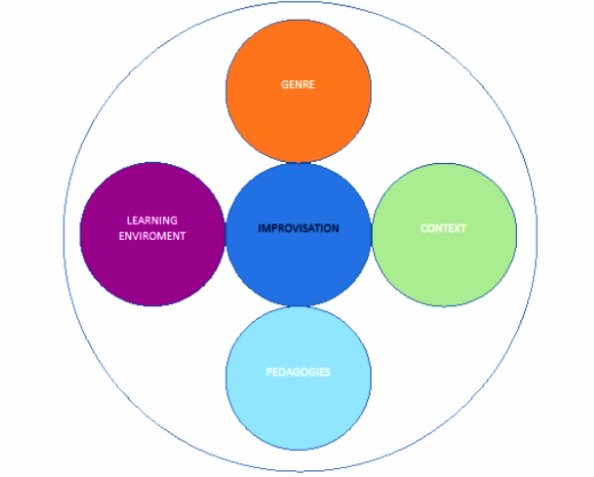
A Model for Secondary School Music Improvisation (Conclusion)

Define what improvisation Means to You  

Most people may think of improvisation as an ‘on the spot’ act, but that is just the tip of the iceberg. Good improvisers plan and practice enough ‘musical vocabulary’ to perform from memory, in the moment, in any context and many ways. Improvisation takes on different forms, whether a solo within an ensemble performance, generating ideas for a composition or embellishing a song structure or chord progression. However you define improvisation, this is what it will mean to your students. 

Genre/Topic     

Genre is essential to learning improvisation as it contextualises the learning and provides students with a framework for the vocabulary they will develop. The first thing to consider is what genres/topics you are comfortable modelling and teaching. There is no point teaching an unfamiliar genre/topic, as you will not know if the improvisations are stylistically correct. When you choose your genre/topic, introduce stylistic characteristics and typical phrases as you go, with fewer stylistic pointers at the start. You can scaffold more genre-specific traits as students develop their skills and confidence. Composition is an accessible topic. Get students to devise ideas in rehearsal time and perform their creative ideas later. This method does not use ‘real-time’ improvisation but uses improvisation at the heart of the learning. Blues and Jazz are the most straightforward genres, as many recorded examples of great improvisations exist. Some of your students may already know that Jazz uses improvisation.     

Curricular/Co & Extracurricular    

It is noteworthy to consider whether you want to teach improvisation for curricular, co/extracurricular teaching or both. Your choice depends on your cohort, class size, available breakout space, equipment, department’s schemes of work and plan and ethos for the learning. Your vision for improvisation will be necessary for how it fits in with the teaching; curricular improvisation allows it to be accessible for students regardless of instrumental skill and explores musicianship skills to develop their improvisation vocabulary. Co/Extracurricular teaching will enable you to work directly with the musicians/singers in your department to establish improvisation skills in ensemble and performance contexts. Both pathways will help your students with confidence in performing and social skills and provide a place where ‘mistakes’ are very much part of the learning process and essential to learning.      

Strategies, Activities & Methods    

Scaffolding is key, as well as using practical starters, main tasks and plenaries to get students listening and engaged musically with improvisation. Starters should focus on using body percussion/movement and voice to focus on repetitive call and response (teacher-led then moving to student-led) tasks designed to engage the ear and quickly get students improvising. Patience is key; students will be scared/reticent at first but will warm up once they feel safe doing the task. How you plan your student’s learning is important too. Do your students learn improvisation individually? Or in groups? Do they practice their improvisations to a backing track? Whatever you plan for the learning outcomes will determine what they show you as improvisers.    

If you plan for performance-based improvisation, the best place to start is with instruments. Keyboard/pianos are the obvious choices, but xylophones are just as effective in connecting the instrument with creativity. If you use keyboards/pianos, the back keys (pentatonic notes) are easy to teach call and response patterns and get students to make their improvisations. Keyboard/Piano’s are great at improvising chord progressions/shapes. White keys (C major/A minor) present a more significant challenge, so narrow the keyboard area to an octave for less confident students and encourage a broader range for more confident ones. Stick with triads/dyads (root and 3rds) for the less confident student and inversions/extended chords for the more assured. Black/white keys can also be great for composing a piece in binary form as students learn to improvise using both sets.    

Whether your students are performing or composing using improvisation, creating a template/guide for them to follow is a must.  Developing improvisers requires a bank of ideas to form their musical vocabulary, so careful planning, encouragement of repetition and decision-making are essential. A good way to capture improvised ideas could be to write /record ideas, like a diary. This can satisfy learning progression, demonstrate that students have used aural skills, and show understanding of the learning outcomes too.     

Developing a student’s understanding of rhythmic patterns and grooves is necessary to improvise fluently. Students need help with rhythmic improvisation more than melodic or harmonic. Students struggle with cognitive overload, not knowing what to do next, and not having a strong rhythmic vocabulary to fall back on. This is where the ideas bank comes in handy, as it will help students learn and recall ideas to be used for melody or chords. Avoid focusing on numbers and words when demonstrating improvisations and focus on shapes and metaphors. The less information students can process to access improvisational activities, the better. Ideas can be borrowed from what students already learned, i.e. using straight quavers to play a jazz pattern, with compound (swung) quavers introduced later once they build upon prior knowledge to add to new knowledge. Having a sound understanding of stylistic grooves will also be a factor in your improvisation teaching, and this can be developed through call and response, along with clear exemplars of improvisations that model what you teach. Just be mindful of these examples; the first chorus of jazz solos is good to play as the soloist usually takes a while to warm up, and you would not want to scare off students by playing a blisteringly fast and technical solo from the start!  

Be mindful of the learning outcomes and create an assessment plan that is authentic to the improvisation you teach. Fluidity, articulation, theme and repetition could be areas you wish to assess. Differentiate for different outcomes. Improvisation can take many forms, whether melodic (selecting notes from a scale), using rhythmic patterns, or comping a chord progression. A well-planned and challenging lesson is achievable even if the results do not show initially.  Be patient: students develop at different levels, and it takes time for improvisation vocabulary to become embedded.

Supporting Your Student’s Improvisations  

It’s a defining characteristic in professional careers and expresses one’s identity as a creative artist. Improvising can be a transformative experience for your students and help unlock the creative potential for new and exciting music-making.

Most of your students might not feel comfortable with improvising, and the very nature of making music without some form of notation or structure is scary for some. It can also be utterly petrifying and put even your most talented students into a situation where they feel like beginners; after all, creating music without notation is scary! Therefore, an environment where ‘mistakes’ are encouraged as part of the learning process and used as part of improvisation is crucial. 

Ensure you give them enough opportunities to improvise in front of people beforehand, letting them know beforehand that it’s ok if they choose not to. Improvising can be a transformative experience for your students and help unlock the creative potential for new and exciting music making, it can also be utterly petrifying and put even your most talented students into a situation where they feel like beginners.    

Be mindful of the learning outcomes and create an assessment plan authentic to the improvisation you teach. Fluidity, articulation, theme and repetition could be areas you wish to assess. Differentiate for different outcomes; improvisation can take many forms, whether melodic (selecting notes from a scale), use of rhythmic patterns or comping a chord progression. A well-planned and challenging lesson is achievable even if the results do not show initially. Be patient: students develop at different levels, and it takes time for improvisation vocabulary to become embedded.

Finally, encourage your students to take risks and celebrate successes! It’s tremendously brave of any young musician to stand up and perform an improv, so do not dampen their spontaneity to improvise, even if you are working on non-improvised topics. You will know the true extent of your success when students incorporate improvised ideas in your lessons or produce a solo/piece of music with confidence and imagination.   


Wright, 2023

This proved quite challenging when trying to summarise my research into a succinct and accessible model, albeit one that is in its infancy regarding introducing the idea of improvisation in secondary music education. I will say that I have been overwhelmed by the music community’s response to this, and I have been privileged to speak at a Music Teachers Association conference, Jazz in Education, Music & Drama Expo and Curriculum Music conference within the first year of finishing my Masters. I will post a blog (maybe Vlog, but it has been a while since I’ve done one!) later on, but for now, I thank you, dear reader, for supporting the work I do, and I am excited about the potential impact of our collaborations in developing improvisation and putting it back in its rightful place in music education.

Best wishes,

Michael Wright

Larsson, Christina, and Eva Georgii-Hemming. 2019. “Improvisation in General Music Education – a Literature Review.” British Journal of Music Education 36 (1). Cambridge University Press: 49–67, p.59-60.

Merriam, Sharan. 1988. Case Study Research in Education: A Qualitative Approach. Jossey-Bass, p.169-170 


Sarath, Ed. 2009. Music Theory through Improvisation : A New Approach to Musicianship Training [Electronic Resource]. Routledge, p.43-83

Music Improvisation in UK Secondary Schools: Part 7

In this series, I will present parts of my dissertation, ‘What strategies, activities and methods would help develop the teaching of music improvisation in UK secondary school education?’. I aim to give you insight into my improvisation research by informally presenting my findings, opinions and thoughts. It may start a discussion of the justifications, merits, and advocations for music improvisation or completely put you off and double down on why improvisation should be left out of music education. Either way, I believe it’s a meaningful conversation.

Results from Interviews

Background

For the second part of the results, I interviewed four participants. All interviews were conducted face-to-face and provided opportunities for participants to express their thoughts and opinions verbally, through instruments (mainly piano, though one brought a saxophone), or through demonstrating strategies, activities, and methods with me.

Each participant’s role in current music improvisation development and advocacy is divergent and offers different perspectives.

ID ‘A’ is appointed as the International Chair in Improvisation, former Head of Jazz at a London Conservatoire, and member of the Association of European Conservatories.

ID ‘B’ is a prominent jazz bandleader, educator, and performer with over 30 years of experience, having performed with many influential musicians. They also wrote a show to introduce jazz music and improvisation to primary school children called ‘Molly and the Owl’.

ID ‘C’ is an educator, broadcaster, and host of a podcast about music education that has been shortlisted for many awards. They also use improvisation as part of their teaching practice.

ID ‘D’ is an animateur of music, a broadcaster, TV presenter, bandleader and restauranteur. Throughout their career, they promoted improvisation through keynote speeches, TV shows and as an artist.

All interviewees cited a lack of opportunities to learn music improvisation in their curriculum secondary music lessons, with ‘B’ having curriculum music lessons up until uppper school (following a three schools system, popular in the 1980’s). An ‘O Level’ music was not an option for him.

ID A was trained as a Western classical French Horn player and learned to improvise before their further education. ID C’s music education came from the Anglican church, cathedral choirs and brass bands. ‘D’ comes from a similar background, orchestral, eventually taking up the Saxophone and learning ‘formally’ i.e. stave notation. The relationship with the saxophone developed into an extension of musical identity, where she felt ‘it was my voice, as opposed to all of the other instruments I played’.

Opportunities to develop improvisation skills happened out of school, learning alone or with little assistance from music departments or teachers. There were transformative moments when discovering how to improvise, showing an inclination for self-discovery and having an innate ability to improvise; in ID B’s case, he had a profound experience which shaped his values as a teacher of improvisation. Their transformative moment occurred after discovering how chord symbols work in notation (Joseph and his Technicolour Dreamcoat). ‘I realised that if I could figure out how to play these chords, find a system, a code, then I could be free (expressive) in the music, and I could improvise an accompaniment.’

This is comparable with ‘D’ who, after spending time learning the basics of musicianship and theory, had a realisation when they started to improvise without the need for reading music, using their ‘ears’ (an expression used to identify ideas gained from musical imagination and aural skills), helping ‘D’ express the emotions she felt at the time, something that was implied as missing from the music she had learned previously, thus beginning a reflective journey to go beyond the boundaries of her music education.

Despite a similar affirmation, the piano teacher of ‘B’ did not share this and was dismissive: “We don’t deal with this rubbish here!” (improvisation over Jazz standards) And then she just literally, like, just chucked it (the Jazz standards book) away. Literally threw it away, you know, on the floor. So I was like, wow!?’

ID B’s negative experience shaped his teaching ethos. It profoundly impacted how he supports students with their self-expression, as evidenced by his determination not to allow the teacher’s dismissal of his discovery of improvisation to affect student’s discoveries.   

‘D, on the other hand, had a more supportive teacher who encouraged her to develop creativity by modelling, supporting, and offering advice on developing improvisation skills; a crucial moment came in the lesson when D learned to improvise over the Jazz standard, ‘Stormy Weather’.

Other early experiences were not so obstructive. ID C discovered his transformative moment by being put on the spot to solo in a big band performance despite never improvising up to that point. It positively affirmed his relationship with improvisation, discovering the excitement of improvising.

All interviewees’ experiences of developing improvisation skills varied during Higher Education, except for ‘D’ who did not study music during her undergraduate education. ID A and B studied at Conservatoire, with A’s connections to future influential jazz musicians evident in his development to his status as a musician and educator. However, his development came from working with and learning from experienced and established jazz musicians outside of the educational environment. There also were the beginnings of a split music education, where all improvisation learning takes place outside their formal education.

Definition

Definitions of improvisation varied throughout the interviews, with the interviewees opening up about their own experiences and beliefs. References to the relationship between the self and music theory were sparse but focused on the comparison to genre vernacular, a cognitive approach, and composition, with this poignant quote attributed to Lionel Grigson:’ Improvisation is composition without the benefit of hindsight.’ Genre and learning by ear were also included.  

All responses expanded upon the Model Music Curriculum’s definition, offering insight into each interviewee’s relationship with improvisation and rationalising a frustration with the MMC’s definition of improvisation. Though ID A adds this caveat, ‘implicit in our experience is experience. And much of our experience as improvisers is in our strategic choices we make in terms of practice and preparation, before we improvise with other people’.   

These ‘strategic choices’, improvisational practice and preparation, could relate to composition, ID B and C mention this, with the former stating, ‘the things which affect composition effects improvisations, the things that we would agree make a good composition also relate to the improvisation.’   

Genre, Non-Genre or Both  

References to the genre were often associated with blues (blues scale, 12-bar blues, etc.) and jazz, with genre being highlighted as necessary when teaching improvisation in secondary music. ID C argued that blues is ubiquitous with pop and rock music phrasing and melodicism; therefore, it is easy for students to engage with improvisation as they are already aware of it. ID A references the Jazz standard for ‘What Is This Thing Called Love?’ for GCSE students to help them understand chord tones (intervals), cadential harmony and Tierce de Picardie.  

ID C agreed with genre’s importance in improvisation. However, he stated that teachers should wait to introduce it so as not to confuse students and take anything away from the learning process. ID A and B agreed that ignoring genre in improvisation will be problematic later on due to musicianship skills needing to be embedded enough for memory recall and would be confusing if a teacher were to engage with a fusion of genres. ID A’s frustration with the assumption that ‘anything goes’ when it comes to teaching improvisation or a chaotic, unplanned and ‘on the spot’ approach to teaching ‘messes up the learning process’ adding, ‘If we do that with kids that anything goes, the music will sound chaotic.’   

Reference of genre material from an education standpoint highlighted Jazz and the American Songbook, but the focus on fundamentals jazz pedagogy was underlined through the ‘teaching and learning principles of learning by ear and through the body and through the voice and the principles of memory and improvisation, harmonic and rhythmic literacy.’ (ID A)

ID A’s reference to ‘Genre Wars’ i.e. the argument for not teaching genre due to its’ ‘exclusive and elitist’ connotations and diversifying music to be about ‘less genre’ is unethical. He argues that ‘They’ (those against) ‘haven’t actually evaluated the outcomes of different strategies to improvisation’ that other disciplines would not debate this and ‘its amazingly unethical for those people to pontificate about that, without knowing the strategies, what strategies are, and what how the outcomes are occurring, and then have a go anyways’.

His view is not dismissive of people accessing Conservatoire through genre-associated improvisation study and the importance of knowing stylistic and musical nuances. For the sake of improvisational teaching accuracy and authenticity, ID C recalls a memory when covering Rag Desh for his GCSE class but not being in a position to confidently say to his students if it was a good improvisation, stressing that teachers need to be in control of improvisation assessment, ‘A teacher who doesn’t know anything about blues or jazz trying to teach blues scale, and I’ve seen distinguished musicians demonstrating a blues improv, it’s just horrendous and the kids model it on that and they play something that’s awful, un-bluesy and has missed all useful styles.’

ID D believes that genre can be implied through the backing of improvisation, ‘I’ll say, give me some Afro Beat. The scale that we’re we’re improvising is exactly the same (as other genres), but all I’m doing is trying to get different rhythms out of you’, continuing with, ‘if I want them to now focus on their feeling, we’ll play something like a ballad….the genre will help them bring out the different styles, syncopation, legato, whatever it is changing (the) playing.’

Strategies, Activities & Methods

Strategies, activities and methods varied among the interviews and interviewees’ responses. ID C’s approach came from an instrumental jazz musician’s perspective, a non-generalist approach that specifically wants to learn jazz improvisation through a jazz musician’s transcription, exploration, and performance approach. 

His approach also uses composition, Blues music, and encouragement to break down improvisation’s intimidation factor: ‘I find giving them pointers, less stylistic pointers is useful’ by choosing exemplars that demonstrate accessible models in improvisation. Listening is crucial to ID C’s rationale for learning improvisation.

ID B’s approach focuses on individual piano lessons rooted in melodic and harmonic activities. This allows space for students to explore, make mistakes, and learn from his exemplars. He also uses creative workshops (at primary school level), using his project ‘Olly and the Owl’ to encourage jazz listening skills and instrumental improvisation.

ID A’s strategy is based on a neurological study, engaging with the ‘left’ and ‘right’ sides of the brain to explain why people find improvisation challenging to learn (perhaps teach?) and suffer from cognitive overload: ‘If you talk about improvising, if you provide visual symbols for improvising, certainly with words and numbers, rather than shapes, of if there not metaphors, then you’re going to make it much harder to improvise, and you have to undergo a translation from the left brain cognitive analytical to the synthetic cross domain. The left brain can only work in one domain at a time, whereas the right where you can go multiple domains, more or less simultaneously’.

ID D’s method works with a similar ethos, starting with a symbolic action of getting students to remove music stands in an ensemble rehearsal; she coaxes the musicians to reveal their inner musical voice not through musicianship skills but through careful scaffolding of emotional support and encouragement to rid themselves of inhibitions. D models this by demonstrating her sound is not perfect, ‘I play with a metal of mouthpiece on my saxophone, and it’s a squeaky mouthpiece that squeaks all the time. And I’ve learned just to know that that is part of my sound’. She goes on to explain further, describing a holistic master student model where students are supported in improvising via prompting the music based on latent skill, ‘it’s almost like somebody revealing their inner self, revealing their inner thoughts, and you have to, you have to treat it with respect, and you have to treat it softly’. Her band supports the students, who vamp a groove or simple chord progression for as long as the improviser needs, taking turns to solo.

Learning Outcomes 

For these results, successes and failures are defined for strategies, activities and methods, playing experiences, teaching and attitudes, and philosophies regarding improvisation in secondary schools.   

Participants’ experiences of improvisation in secondary had mixed results. ID C’s early success with his transformative experience mentioned before gave him a positive grounding to continue with it in his teaching career, but he expressed a lack of confidence when comparing his skills to ‘people who’ve dedicated their lives to doing it’ and emphasised with fellow teachers who lack the experience to teach it to secondary students confidently. Confidence is mentioned again for good modelling of improvisation, as is to be aware of one’s skill as an improviser regarding grading and quality. Success represents the quality of improvisation as a model vs. the failure of quality and poor practice modelling for students.

ID A framed successes and failures from a pedagogical perspective, failure by not creating a reliable method of teaching improvisation. His tenet is that ‘improvising requires some things to have been learnt previously, to be in the present.’ he underlines difficulties when expected to improvise on the spot and lack of ‘informed discussion’ on improvisation’s ‘multi-layered set of phenomena’.  

Politically, funding for PGCE Music bursaries was omitted from the Department of Education Initial Teacher Training (GOV.co.uk 2022). This represents a failure in getting music graduates, let alone jazz graduates into teaching to help promote and develop improvisation in secondary schools (though this may change under a new DoE). The Jazz In Education organisation mooted a potential model for improvisation in secondary. Aimed at the key policymakers who can influence national curriculum to ‘create some momentum around the discussion about what’s really necessary to enhance music education in this country.’ (ID A) by acting as a ‘well-meaning catalyst’ by advocating for a jazz specialist in a music department (Ibid) and ‘inform decision making policymaking strategy about music education in the UK to enhance it.’ (ID A and C). ID D mentions the issues around assessing improvisation, specifically how to create criteria for evaluating, citing an example of an improvisation playing outside ‘the changes’ and the difficulties of grading it, despite this type of solo heard at prestigious music venues such as Ronnie Scott’s.

ID B’s view stems from a peripatetic standpoint, with an example of his student connecting and identity with improvisation. When describing a student’s experience with learning improvisation, the student was technically advanced but could not overcome their inhibitions towards improvisation and how it made them feel. He also felt that music teachers would view improvisation as ‘a bit of fun at the end of the lesson, it’s just a bit of a tool’, questioning how teachers plan the teaching of improvisation in lessons long term, lack of pedagogical development, ‘even 20-30 years ago, when I was studying there was this ‘we need to bring improvisation in the classroom’. ID B values the legitimacy of improvisation’s value in education ‘as an art form in its own right’ and music education’s indoctrination on students that music must be played as written regarding exam boards: ‘There’s one recently who, one of the exam pieces I was teaching, they said “I think the ending was how much better if we did this” and I said “well, do it! Why not?” (they said) “because I’m allowed to”, “who’s telling you that you’re not allowed to do it?”, “well its just I’m suppose to do it” (play the piece as written)’.

Benefits

The benefits of music improvisation to secondary education and what secondary education can teach educators from a jazz background are symbiotic. Jazz educators can impart improvisation pedagogy and, by proxy, improvisation skills to secondary education, with secondary imparting lesson and curriculum organisation skills to jazz educators (ID A and C). Improvisation was also credited with helping understand classical music, using an ‘improviser’s mind’ to analyse and explore pieces in greater detail and further develop an understanding of the composer’s intention. (ID A and B).

‘B’ created another transformative moment when realising his disconnection with classical music was related to how he was taught improvisation was also mentioned to benefit confidence, identity and self-expression (‘C’), with the former referring to having enough ‘vocabulary’ (analogy for improvisation knowledge in a given style) to cope with the unexpected at his job interview at his school.     

Improvisation, from a personal perspective, allows for musical development without relying on sight-reading, ‘It forces me to look at how I present music in a number way. I think it’s why I developed as an improviser; I want to be able to play music I couldn’t read properly.’ (‘B’)

Improvisation was also mentioned in helping to embed knowledge, by creating ‘another layer of understanding in this in the realm of sound about what has been memorised.’ (‘A’), hypothesising that music can only be learnt through ‘the realm of sound through singing and embodiment’ and strategies for learning music, key outcomes’ need to have an improvisatory element in order to be learned deeply’.

‘D’ advocates for music education to create space in the curriculum for students to learn improvisation and to develop their expressive qualities (Note: also helping to channel emotions too?). The benefits of this are that students create ownership of their music, creating a relationship with it and empowering them to regard music as boundless, ‘You’ve heard me speak about getting young people engaged in music, showing the power of the music. But, that comes from when they have that magical feeling, you know, and that doesn’t come from just sitting in a class and sort of looking at the whiteboard or listening to a piece of music. It comes from the creativity, but also giving the young people license to say, do what you want. There’s no real (wrong) notes.’

Music Improvisation in UK Secondary Schools: Part 6

In this series, I will present parts of my dissertation, ‘What strategies, activities and methods would help develop the teaching of music improvisation in UK secondary school education?’. I aim to give you insight into my improvisation research by informally presenting my findings, opinions and thoughts. It may start a discussion of the justifications, merits, and advocations for music improvisation or completely put you off and double down on why improvisation should be left out of music education. Either way, I believe it’s a meaningful conversation.

Ethics and Acknowledging Biases

For the first part of the results, I surveyed twenty-two participants via social media through Twitter (X) and Facebook posts. All were working in UK education.

All interview participants, including those transcribed, come from a jazz background. This was not by design but was chosen based on recommendations, availability, and participant’s willingness to partake in the project (a consideration as a bias given the relevance of the research for genres outside of jazz). Therefore, my questions for the survey and interviews did not mention anything genre-related or any reference to jazz music, and it would be at the discretion of the participants to refer to genres they associate with improvised music.

Verbal and written language was also considered, ensuring not to colour or distort responses. Use of language connects ‘our research to audiences’ (Leavy 2017, 29); any reference to jazz vernacular, such as slang terms for describing musicianship, will in some way be translated into a ‘mutually understandable language’ (Ibid) in order not to alienate the reader from a different musical background.  

Subject knowledge and research expertise needed to be evident when interviewing and surveying participants, as was communicating with open, friendly and non-judgmental personality traits to enable access, empathy, rapport and trust with self-conducted interviews. (Cohen, Manion et al. 2011). This was important in bringing out the ‘wholeness’ and ‘integrity’ (Ibid, 296) of participant’s experiences, connecting them with the case study and providing a safe platform to do so, in keeping with an ethnographical representation or construction of their ‘social reality’ (Leavy 2017, 145).
How does the research design represent or construct the reality of secondary school improvisation experiences? Paying attention to one’s reality/construct and contrasting with the participants, both qualitative and qualitative data, would be a start, as would comparing the ‘validity, reliability and representativeness’ (Ibid) of responses with the literature review and other results to assess the quality of strategies, activities and methods. 

Ethical considerations regarding informed consent were also paramount to the clarity of research or a detriment to the methodology as ‘the more participants know about the research, the less naturally they may behave’ ergo, ‘naturalism is self-evidently a key criterion of the naturalistic paradigm.’ (Cohen, Manion 2011, 228) A possible contention of participants being aware of the nature of research and freedom to express opinions of the methodology could be participants own bias for/against music improvisation in secondary schools or embellishment/exaggeration of their strategies, activities and methods, thus making it hard to control the phenomena that is being researched. That is why my survey data was carefully scrutinised to avoid objective, personal comments, and interviewees must be given opportunities to demonstrate their input by playing what they think works for music improvisation. 

Cohen, Louis, Lawrence Manion, Keith Morrison, and Richard Bell. 2011. Research Methods in Education. [Electronic Resource]. 7th ed. Routledge, p.228-229, 289-296

Leavy, Patricia. 2017. Research Design : Quantitative, Qualitative, Mixed Methods, Arts-Based, and Community-Based Participatory Research Approaches. Guildford Press, p.5-10, 27-30, 129-148

Results from Survey Questionnaire

Background/Training

36.3% learned improvisation in their musical training/background, which decreased to 27.27% when training to be a teacher.   

Figures show that despite a low percentage, 86.3% teach improvisation as part of their curriculum, with 45.45% teaching improvisation as part of their co/extra-curriculum. 9% of teachers with training/experience do not teach improvisation in their curriculum but teach it in extra/co-curricular. 

Definition of Improvisation

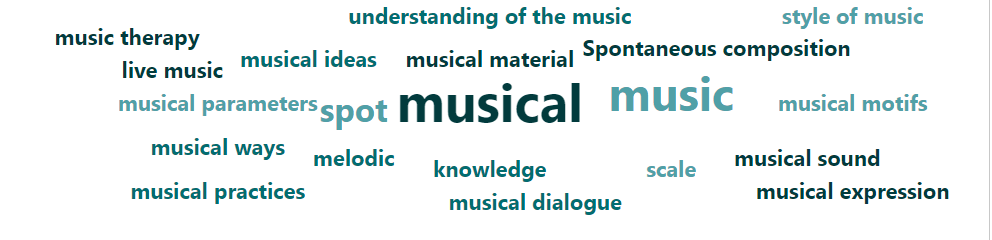
Teachers from an improvisatory background (36.3%) defined improvisation using themes such as ‘in the moment’, ‘play’, and ‘collaboration’. 13.6% used Western musicianship terms to describe improvisation, and 2% referred to ‘learned knowledge’. All respondents used the terms ‘in the moment’ and ‘on the spot’ in their descriptions.   

63.6% who identify as having no improvisational background define improvisation as similar to those with a background, adding adjectives such as ‘spontaneous’ and ‘freedom’ and referring to ‘boundaries’, either musical or creative. However, it’s unclear whether this relates to a hindrance or adherence.

Highlighted responses include:  

  • ‘Improvisation to me is the freedom to creatively express oneself through playing or singing music. I did a music therapy training and so i use totally free improvisation’ (ID7)  
  • ‘In the moment musical expression which can be either totally free or guided in some way with scaffolding (e.g. agreed chords or limited choice of pitches or rhythms), and which is not written down or notated.’ (ID15)  
  • ‘Impulsive playing drawn from learned knowledge’ (ID3)  
  • ‘freeing musicians from the dots is one of the most musical ways into composition a challenge that binds and combines intellect, ear and physical technique very cool and a load of fun’ (ID4)  
  • ‘Having the tools (chord structure and/or scales) and the freedom to create your own melodic/rhythmic segment to show off your understanding of the music and how to showcase your ability as a performer (like a cadenza) and as a master of your instrument/style of music…’ (ID10)  

ID17, who identified as someone with no background/experience in improvisation, playing or teaching, referenced genre (jazz) in addition to spontaneity and ‘in the moment’ as descriptors. 

Figure 1: Word cloud taken from questions relating to ‘Definition of Improvisation’.

Rationale for teaching improvisation (linking with strategies/activities/methods)

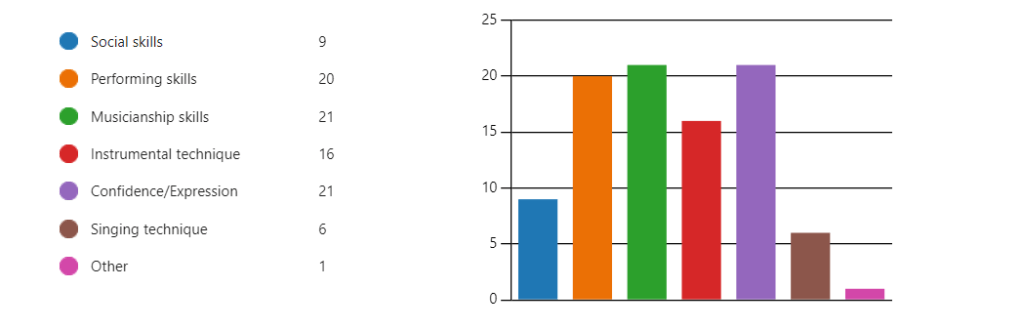
77.2% thought improvisation helped with ideas for composing. ID10 and ID19 highlight this, with ID10 stating, ‘I find improv helps students then moving onto basic composition in our following chords and melody and know how to use the notes of the chords/follow the chord structure to help improve ideas which are then later refined into “formal” melodies.’ (Q.28) 

63.64% felt it helps students to improvise when performing, and 54.5% for developing instrumental skills. 

27.2% mentioned blues music as the most popular genre when teaching improvisation.

ID3, ID13, ID15 and ID18 highlight confidence, identity, ownership and self-belief as a benefit of learning to improvise, with a sense of pride from ID18 seeing students supporting each other. ID15 states that as performance and musicianship skills develop, their students become ‘more adventurous’ as students play ‘around more with the formula’.

ID18 stated that teachers must adopt ‘good management of classroom dynamics’ for students to learn improvisation. 

Figure 2: Data to highlight the intra/interpersonal and musical skills that students can benefit from when learning improvisation

Strategies, activities and methods (Curricular)

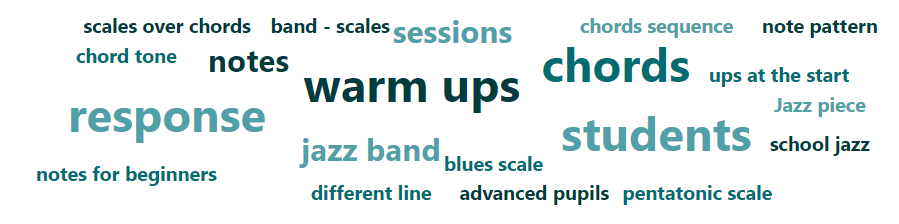
54.5% reference melody (scales, mode etc.) when teaching improvisation in the curriculum. Due to their inexperience, ID20 uses ‘classroom workshopping’ to teach their students and themselves how to improvise. This includes ‘Circle games, e.g. pass the pulse, or I play/sing you play/sing to model ideas, followed by ‘solos going around the circle’ and ‘modelling ways to build on ideas they come up with, then inviting them to pick an idea and just play/song together.’

ID20 uses backing tracks with a ‘strong and steady groove to help hold the music together’. ID4 uses ‘cells/cycles/ostinati/chord sequences (some kind of groove)’ scaffolded for ‘students focus on rhythmic interest and gradually expand pitch’. ID5 mentions ‘If you can sing it, you can play it.’ regarding philosophy. They highlight singing as a conduit not to be ‘restricted by instrumental skill/availability etc’. This leads to a ‘build up a bank of short riffs (if teaching blues/jazz) based on food rhythms. These are then threaded together to increase fluency.’

ID7 uses improvisation for their work in a special school as a ‘sounding board’ by making musical sense of what the students present. I do this either in a group or individually.’ Scales and the use of pitches for improvisation are encouraged.  

68.1% engage with strategies/activities/methods for co/extracurricular activities, jazz being the most popular, with 27.2% who use it. Regarding jazz improvisation, ID6 uses a harmonic exercise to ‘write a crotchet chord tone at the beginning of each bar which matches a chord, i.e. E for a C7, etc. I then get students to begin a solo by starting with the chord tone, and they have to play a phrase that leads up to the next bar’s chord tone.’ ID10 also eludes to a similar approach but simplifies this as a “fill the gap” exercise, ‘Give it a different mood / play with the musical dimensions. 

Figure 3: Word cloud taken from questions relating to ‘Strategies, activities and methods (Curricular)’

Support for Improvisation

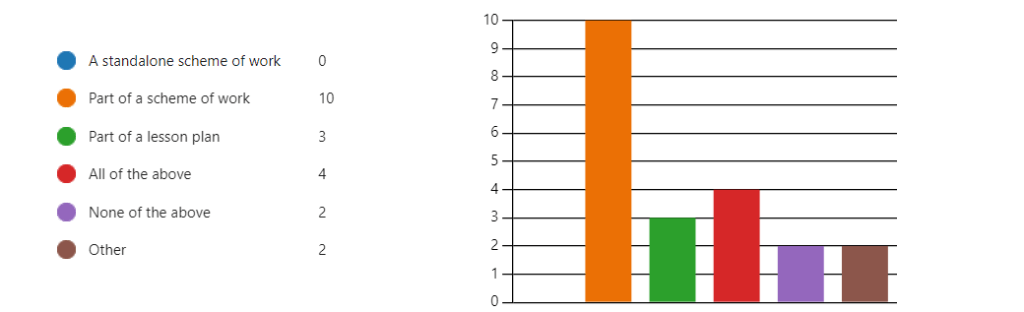
45.4% of responders would like to use improvisation as part of a scheme of work, with 18.1% for co/extracurricular as a part of the lesson plan. 27.7% want to use improvisation specifically for jazz band/ensemble practice. ID22 requested schemes of work to help with planning, and ID5 requested activities to help with string groups (Grade 4 instrument level). ID19 referred to external pressures regarding results at school and would like more time to develop and research improvising strategies/activities/methods. 

Figure 4: Data to support the participants best use of teaching improvisation in their practice (Curricular)

Issues

27.27% say a lack of personal experience and student’s difficulty understanding improvisation are barriers to learning. The same percentage say they do not come across any issues. 22.7% also state that a lack of improvisation performance, assessing and creating lessons in their curriculum is an issue for their teaching.    

ID2 said teachers need to feel comfortable teaching improvising if they do not improvise and recommended training. However, they acknowledged CPD budgets and ‘whole-school issues’ for not teaching improvisation. The type of school and class size are also factors to consider.  

ID6 identified the difficulty in planning/understanding and assessing improvisation as a result of a lack of guidance and the feeling of being an ‘afterthought in education’.

ID11, ID9 and ID13 cite a lack of experience and knowledge as an issue (both knowledge and experience) and transfer this onto their student’s opinions of “sounding bad” and being terrified/lacking confidence to attempt it  

ID3, ID4 and ID19 see no issues with school improvisation, provided it is scaffolded, with opportunities for students to practise an expectation that secondary school teachers should be able to teach improvisation at secondary level. 

Genre, Non-Genre or Both

57% believe that both genre and non-genre led approaches can be used to teach improvisation, with 22.7% believing improvisation can be taught with a genre in mind.  

Those who agree with a combination of both genre and non-genre teaching mentioned it is best to start ‘totally free’, then ‘once confident one can start to introduce structures, chords, and specific genres’. ID7, ID8, ID13.   

ID11 believes some styles (jazz and blues) should follow their associated ‘rules and traditions’. ID20 believes non-genre helps teaching, ‘creative nature of improvising means that it can be applied to any and every musical genre’  

ID6, ID16, ID17 thought improvisation should be taught with genre stated that the history of genre, context, and genre-specific musicianship, ID6, D18, ID22 referenced learning improvisation as a language.  

ID17 stated: ‘Pupils need to know about genre and history. Context of genre means students know about it so they can understand the music.’  

ID6 stated: ‘Improvisation needs to have context. If you’re playing jazz music but haven’t been taught about compound rhythms then how can you play jazz properly?’